

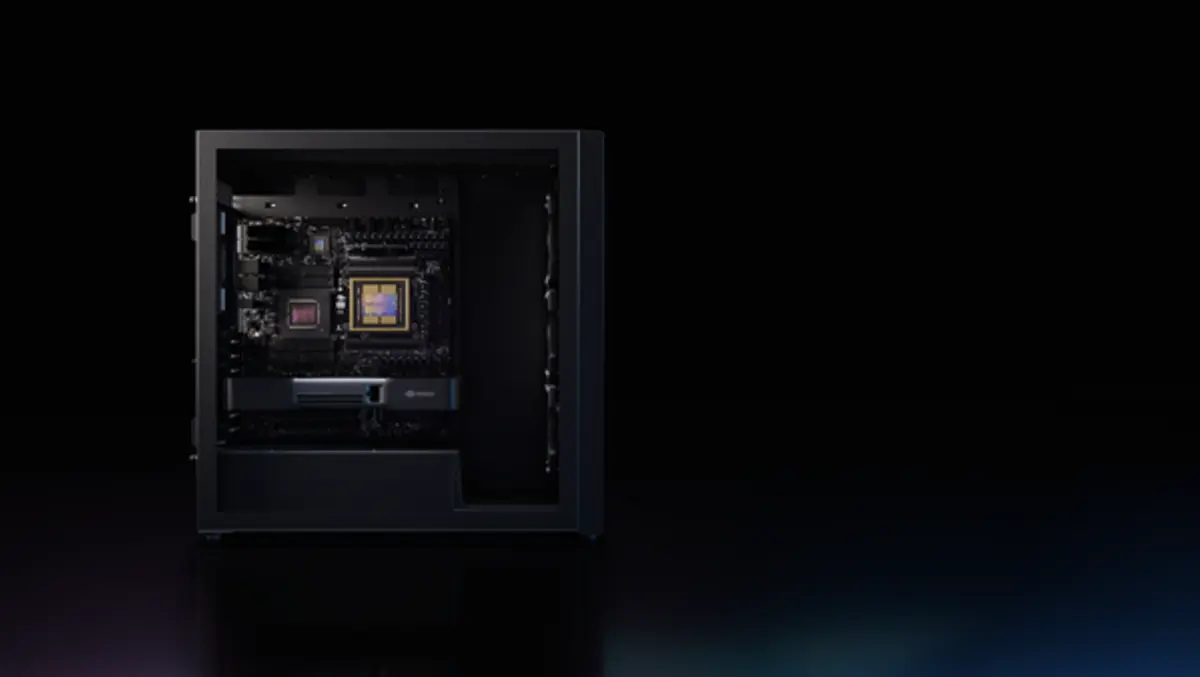
Nvidia unveils DGX Station for Windows AI workstations
Tue, 2nd Jun 2026
NVIDIA has unveiled DGX Station for Windows, a deskside system designed to bring large AI workloads to machines running Microsoft's operating system.
The launch marks a push to put advanced AI development tools inside the Windows environments widely used across large companies, rather than relying solely on Linux-based systems in data centres.
DGX Station for Windows is built on the NVIDIA GB300 Grace Blackwell Ultra Desktop Superchip. The machine can run AI models with up to 1 trillion parameters locally and is aimed at developers, researchers, engineers, designers and data scientists building and deploying AI agents.
The workstation is designed for enterprise tasks including model training, fine-tuning, inference, data science and multi-agent development. It can also run hundreds of agents simultaneously and connect them to business applications and workflow tools used on Windows.
A central part of the launch is NVIDIA OpenShell on Windows, a runtime for autonomous agents developed with Microsoft. OpenShell uses new Windows security and containment features to place each agent in an isolated sandbox and keep policy controls outside the agent's reach.
The approach is intended to address concerns about how autonomous software interacts with enterprise systems, sensitive data and user credentials. OpenShell applies system-level controls so agents cannot override policies or access protected information outside the rules set by administrators.
Chris Marriott, Vice President of Enterprise Platforms at NVIDIA, said the company is seeing rising demand for systems that can connect AI agents directly to the software people already use at work.
"As enterprises scale AI agents across their organizations, they need AI infrastructure that can connect directly to the applications and workflows that power their business," Marriott said. "DGX Station delivers supercomputing-class AI directly into Windows, where millions already design, engineer, research and create every day."
Microsoft framed the move as an extension of its long-running work with NVIDIA on Windows devices and larger computing systems.
"For decades, Microsoft and NVIDIA have partnered to advance the most powerful computing platforms in the world," said Pavan Davuluri, Executive Vice President of Windows + Devices at Microsoft. "Today, we're taking that collaboration to the next level, scaling the full power of Windows from thin-and-light PCs to data-center-class workstations with DGX Station powered by GB300. This unlocks a new class of AI performance on Windows, the platform enterprises trust for security, manageability and compatibility."
System design
The hardware combines a Blackwell Ultra GPU with a 72-core Grace CPU linked through NVIDIA NVLink-C2C. The system includes up to 748GB of coherent memory and up to 20 petaflops of FP4 performance.
It can also be paired with an NVIDIA RTX PRO 6000 Blackwell Workstation GPU for visualisation and simulation alongside AI processing. For networking, the machine includes an NVIDIA ConnectX-8 SuperNIC with support for speeds of up to 800Gb/s, allowing multiple DGX Station systems to be linked for larger workloads.
NVIDIA said the system is intended to fit into existing enterprise management structures. For IT teams, DGX Station for Windows extends established Windows security, compliance and fleet management tools to a high-end AI workstation, while Linux workloads can still be handled through Windows Subsystem for Linux.
Enterprise use
NVIDIA is pitching the machine as a local AI compute node for individual specialists or shared teams. Users can build and run frontier AI agents on the system before moving workloads to larger GB300-based infrastructure in a data centre or cloud environment.
The company also outlined a broad list of intended uses, including pretraining and fine-tuning large models, high-throughput inference, analytics on large datasets held in system memory, and physical AI work that combines AI models with simulation and ray-traced visualisation.
The launch reflects a wider shift in enterprise AI from chatbot-style interfaces to software agents designed to operate continuously, reason over tasks in real time and interact with business systems. NVIDIA argues that placing that work on a local Windows machine could reduce dependence on remote infrastructure for some development and deployment tasks while keeping the software closer to the applications employees use every day.
DGX Station for Windows is expected to be offered by ASUS, Dell Technologies, GIGABYTE, HP, MSI and Supermicro.