

e-con Systems launches 3D depth camera for robotics
Thu, 8th Oct 2026 (Today).webp)
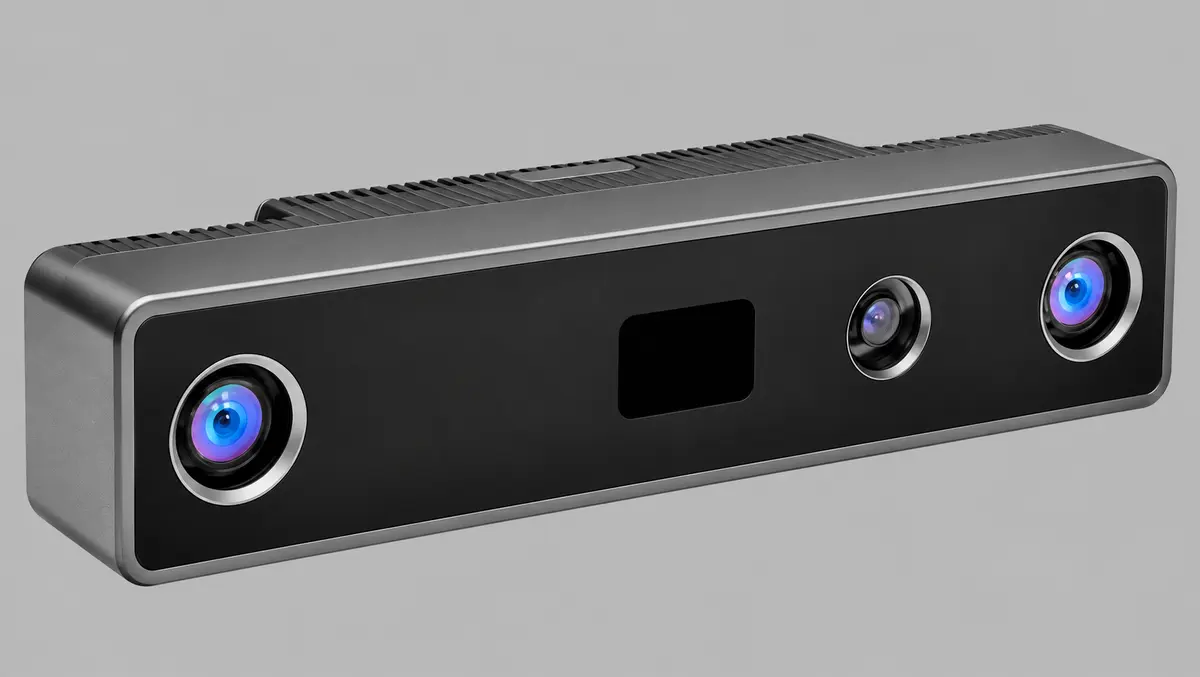
e-con Systems has introduced NetraVis, an active-stereo 3D depth camera for robotics and automation, expanding its embedded vision portfolio into depth sensing for machine perception.
The camera is aimed at applications including Autonomous Mobile Robots, Automated Storage and Retrieval Systems, humanoid robots, and pick-and-place robots. According to e-con Systems, NetraVis is built around dual global-shutter sensors, a synchronised RGB sensor, and an onboard IMU.
The system delivers depth precision with a deviation of 1% or less across its operating depth range. That level of accuracy is intended to support obstacle detection, spatial awareness, and real-time decision-making in indoor environments where robots must navigate around people, equipment, and stock.
Depth cameras are becoming more widely used in warehouses, factories, and service robotics as operators seek more reliable machine perception than standard 2D imaging can provide. Active-stereo approaches are often used when systems need to measure distance while maintaining performance in changing lighting conditions.
Broader line-up
Alongside NetraVis, e-con Systems also detailed a heated-optics camera designed for mobility and cold-environment use. The STURDeCAM31FSH is a GMSL-based camera with an integrated lens heater intended to keep the optical path clear in freezing or rapidly changing temperatures.
The heater can de-ice optics down to -40C and reduce condensation when vehicles or robots move between sub-zero and ambient settings. Such conditions are a common problem in outdoor deployments, cold-storage sites, and autonomous systems that operate across different temperature zones.
Potential use cases for the heated-optics camera include Autonomous Mobile Robots, cold-storage robots, Automated Storage and Retrieval Systems, and autonomous vehicles. Clear imaging in those settings can be critical for safety systems and for navigation software that depends on uninterrupted camera input.
Traffic systems
e-con Systems also outlined an Edge AI automatic number plate recognition camera and a turret camera for traffic monitoring and enforcement. The set-up supports live number plate recognition and pedestrian detection in risk zones.
The traffic offering is designed to work with the company's intelligent transport software suite and CloVis Central, its cloud-based device management platform. The platform handles remote device management and evidence management across larger deployments.
This positions the company across several parts of the vision market, from industrial and warehouse robotics to mobility and urban monitoring. Businesses in those sectors are increasingly seeking systems that combine camera hardware, onboard processing, and management software rather than sourcing each layer separately.
e-con Systems, which operates from California and Chennai, develops embedded vision products ranging from custom OEM cameras to ODM platforms. Its product range includes MIPI camera modules, GMSL cameras, USB cameras, depth cameras, GigE cameras, HDR cameras, low-light cameras, and Edge AI compute boxes.
The company says its cameras are embedded in more than 350 customer products and that it has shipped more than 2 million cameras to markets including the United States, Europe, Japan, and South Korea. Those figures indicate a business that has already established a foothold in specialist imaging components and is now extending further into integrated systems for automation and transport.
Ashok Babu, President at e-con Systems, set out the company's view of the market: "As vision systems take on more demanding roles in robots and vehicles, image quality alone is not enough. Customers need imaging, optics, AI edge processing and system integration to work together reliably in the field. At VISION 2026, we will demonstrate how we are bringing these capabilities together across 3D perception, heated optics and intelligent traffic applications, and discuss how they can be adapted to specific deployment needs."