

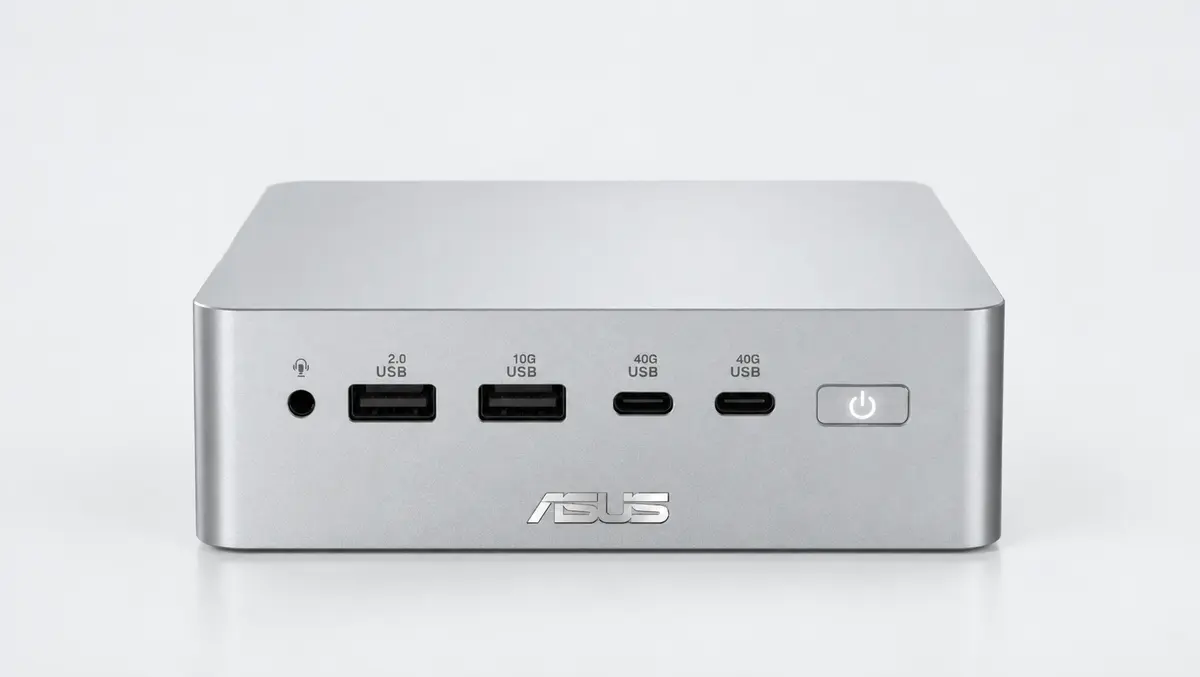
Asus unveils mini PC with 80 TOPS AI chip for local tasks
Sun, 4th Oct 2026 (Today)
ASUS has announced the Ascent QN10 mini PC, which it says is the first mini PC to include an 80 TOPS neural processing unit.
The device uses Qualcomm's Snapdragon X2 Elite platform with an 18-core Oryon CPU and integrated Hexagon NPU, placing it in a growing segment of compact systems built to run artificial intelligence tasks locally rather than relying mainly on cloud services.
ASUS is positioning the system for creators, software developers, and business users who want on-device AI processing in a small desktop format. It is designed for workloads including local large language model inferencing, content generation, language translation, workflow automation, and AI-assisted productivity tools.
At less than 0.7 litres, the Ascent QN10 is much smaller than a conventional desktop PC. ASUS says the chassis is 86% smaller than standard 5-litre desktop systems, making it suited to office desks, studios, and edge deployments where space and power use matter.
The launch reflects a broader shift in the PC market as manufacturers build AI features directly into hardware. Rather than sending every task to remote data centres, newer systems are being marketed on their ability to process selected workloads on the device itself, reducing latency and keeping some data local.
Local AI focus
ASUS says the Ascent QN10 is designed to handle sustained AI workloads while remaining cool and quiet. The Snapdragon X2 Elite chip combines CPU, graphics, and NPU resources to support multitasking, content creation, and applications that use AI functions within the operating system and software stack.
The integrated NPU is rated at up to 80 TOPS, a measure commonly used by chipmakers to indicate AI processing throughput. ASUS says that meets the threshold associated with Microsoft's Copilot+ PC category, which has become a reference point for Windows devices built around dedicated AI hardware.
ASUS also says the system includes Qualcomm Adreno integrated graphics, which it describes as delivering 2.3 times the performance of the previous generation. No further benchmark context was provided in the announcement.
Security layers
Security is another part of the product pitch. ASUS says the Ascent QN10 includes what it describes as a chip-to-cloud approach spanning hardware, firmware, the operating system, and cloud environments.
Listed features include fTPM 2.0 and Microsoft Pluton. Those technologies are intended to protect credentials, encryption keys, and device identity while also supporting management and recovery functions for connected systems.
That emphasis reflects concern among corporate customers that AI workloads may involve sensitive data, whether in internal documents, code repositories, or private communications. Vendors have increasingly highlighted local execution and hardware-based safeguards as a way to address those concerns.
Developer tools
The machine can access Qualcomm AI Hub and the Qualcomm AI Stack, which are designed to help developers optimise, validate, and deploy AI models on supported hardware. ASUS says the hub includes access to more than 175 pre-optimised models and supports bring-your-own-model and bring-your-own-data workflows.
The system is aimed not only at local processing but also at hybrid AI deployments. In that model, workloads can be divided between local hardware and cloud-based large language model services, depending on performance, privacy, or cost requirements.
ASUS says the Ascent QN10 supports agent-based workflows using tools including OpenClaw and Hermes Agent, as well as other agent frameworks. Users can interact with those systems through platforms such as WhatsApp and LINE.
For enterprise and edge use, that hybrid model may be one of the more commercially relevant aspects of the launch. Many organisations are still testing where AI tasks should run, balancing faster local response times and data control against the scale and flexibility of cloud infrastructure.
Connectivity options
The mini PC includes WiFi 7 and Bluetooth 6.0, which ASUS presents as part of its case for use in development environments and multi-device workflows. It also offers high-speed input and output for peripherals and expansion, although ASUS did not provide a full port list in the announcement.
The compact desktop category has existed for years, but AI-focused silicon is giving it a new role in the market. Vendors are now trying to turn small-form-factor PCs into endpoints for local model execution, software development, branch office deployments, and other edge computing tasks that previously required either larger workstations or constant connection to remote infrastructure.
By combining a low-volume chassis with a dedicated NPU and business-oriented security features, ASUS is seeking to position the Ascent QN10 within this emerging category of desktop AI systems built for local and hybrid use.